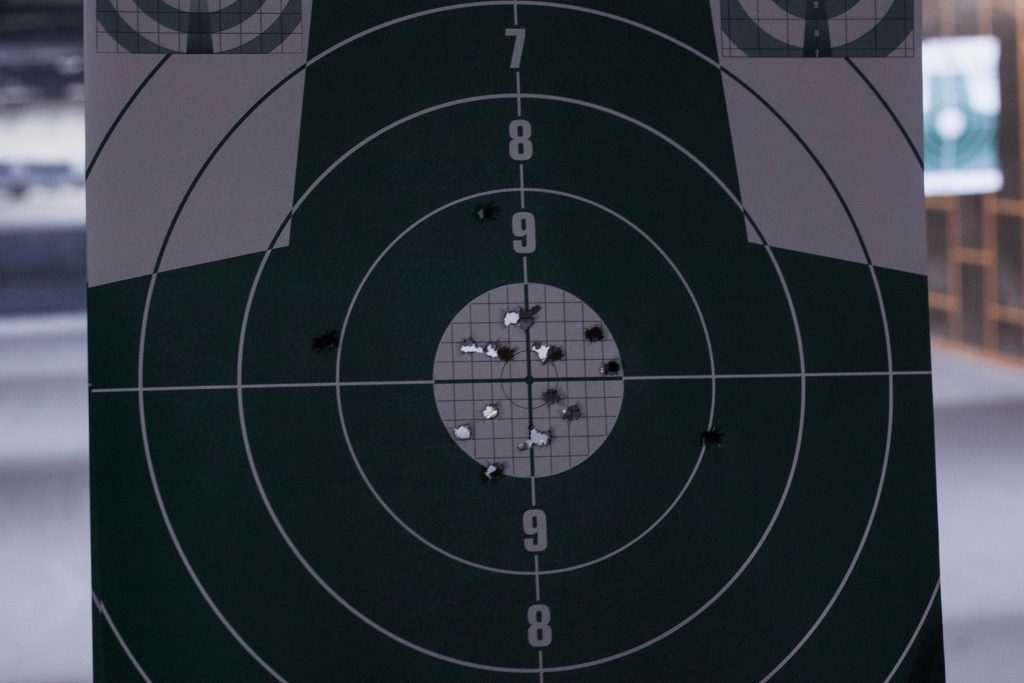
From Safe to Skilled — Hitting the Target Is the Standard
You’ve handled a firearm safely. You know the rules. You know how to load and fire. Now it’s time to shoot well.
Basic Marksmanship courses build on the foundation of our First Steps program — or your existing experience — and take you to the next level. These are performance courses. There is a marksmanship standard to pass. Hits on target are required. That standard is not intimidating — but it is real, because a firearm you cannot aim accurately is not the tool you think it is.
Whether you shoot pistols, rifles, or shotguns, the fundamentals of marksmanship apply across all platforms. We teach them in depth — and we teach them right.
What Every Basic Marksmanship Course Covers
The mechanics of your firearm: Understanding how your specific platform operates — its action, its controls, its quirks — is the foundation of consistent accuracy. We cover the operating systems of all three platforms in depth so you understand not just how to fire but why it works the way it does.
Sights and sighting systems: Open sights, peep sights, optical sights, red dots — different firearms use different systems and each requires a different technique. You will learn how each type of sight works, how to acquire a proper sight picture, and how to use whatever system is on your firearm.
Sight picture and sight alignment: Knowing where the sights are is not the same as knowing how to use them. Sight alignment — the relationship between front sight, rear sight, and target — and sight picture — where that aligned sight sits on the target — are the two most important technical skills in marksmanship. We spend significant time here because this is where most new shooters struggle.
Aim points and target engagement: At Basic Marksmanship level all courses are conducted at distances up to 50 feet. You will learn how to hold on a target correctly for your platform and distance — and how to put rounds consistently where you intend them to go.
Trigger control: The most common cause of missed shots is trigger control — specifically, disturbing the sight picture in the act of pressing the trigger. We address this directly with dry fire exercises and live fire drills until it becomes natural.
Follow through: What you do after the shot breaks matters more than most new shooters realize. Proper follow through is the difference between a shooter who is occasionally accurate and one who is consistently accurate.
The Standard
Every Basic Marksmanship course has a passing requirement. You will be required to demonstrate consistent hits on target at appropriate distances for your platform. This is not a difficult standard — but it is a standard. You will know before you leave whether you have met it, and if you haven’t we will work with you until you do.
First Steps courses are recommended but not required. Students with prior military or LEO experience may test directly into Basic Marksmanship with instructor approval.
Choose Your Platform:
- Basic Pistol — handgun marksmanship fundamentals
- Basic Rifle — rifle marksmanship and Florida Hunter Safety certification
- Basic Shotgun — shotgun marksmanship and pattern control
Ready to move beyond safe and start shooting well? Contact us to schedule.